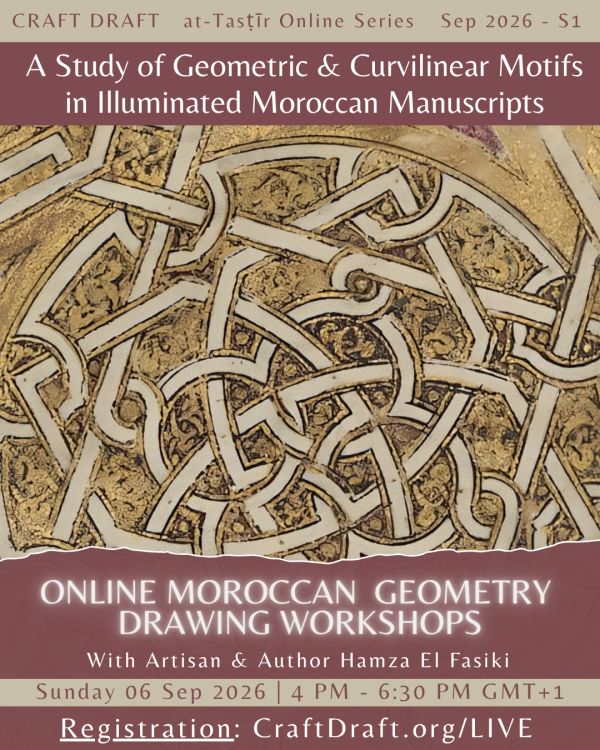
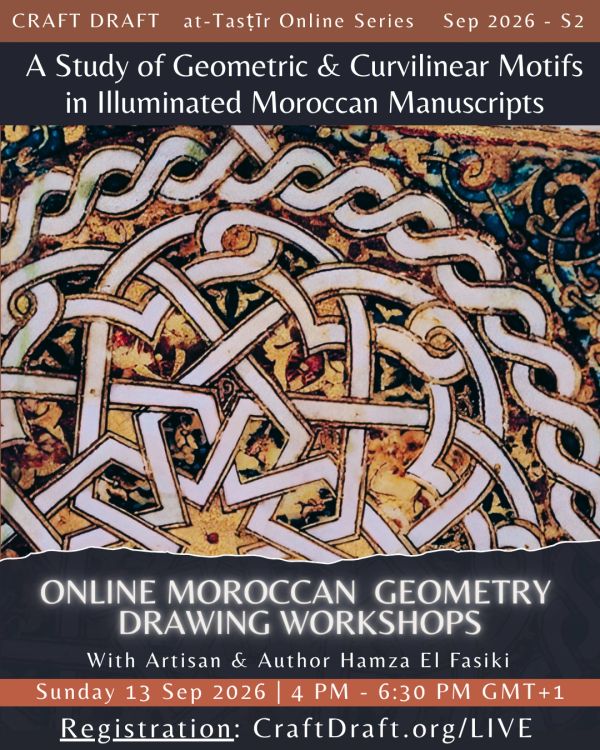
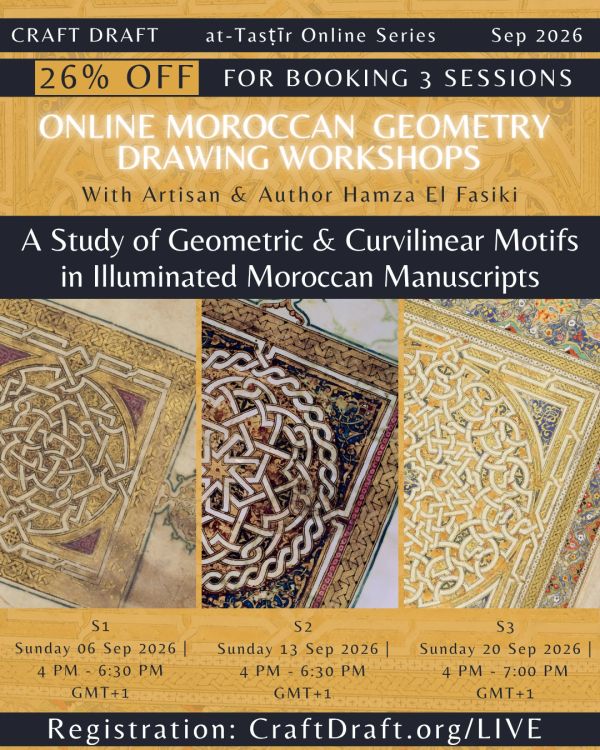
This September 2026, discover the extraordinary geometric and curvilinear patterns preserved in three historical Moroccan/Andalusian manuscripts. This unique online course offers participants the opportunity to study, draw, and analyse three exceptional patterns from rare collections, revealing the remarkable skill and sophistication behind traditional Moroccan geometric design.
The course explores the compositional frameworks that shape both geometric and curvilinear motifs, uncovering their structural logic, proportional systems, and aesthetic principles. Through detailed geometric analysis, participants will learn how these intricate designs are constructed and gain a deeper understanding of the artistic traditions that brought them to life.
Alongside this analytical study, the course introduces traditional Moroccan drawing techniques, with the artisanal Rshim method as the primary framework for pattern construction. This time-honoured approach offers participants a practical insight into the geometric processes and drawing methods used by master illuminators.
By combining historical manuscripts, geometric analysis, and hands-on tracing techniques, participants will develop a deeper appreciation of the mathematical sophistication, artistic refinement, and cultural significance of Moroccan geometric art.
The course focuses on the Mtemen (8-fold). The first session is designed for beginners, the second for intermediate levels, and the final session for advanced participants. Each session offers a progressively deeper exploration of Moroccan geometry, making the course accessible while providing meaningful challenges for experienced practitioners.
Designed for artists, designers, architects, craftspeople, and scholars of geometry, this course provides a rare opportunity to engage directly with historical Moroccan patterns and develop a rigorous, hands-on understanding of the principles behind their enduring beauty.
**Required Tools:**
- Professional Drawing Compass with a 0.5mm mechanical pencil
- Divider (essential for precision)
- 0.7mm Mechanical Pencil for line drawing
- Metal Rulers (30 cm & 50 cm)
- A3 Sheets of Drawing Paper
- Eraser
**About the Instructor:**
Hamza El Fasiki trained as an apprentice under his father since 2011 at the Dar-Attamania Studio in Fes, Morocco, where he earned an Ijazah in the art of at-Tastir and a guild-recognition in the crafts of metal engravings and leather bookbinding. He also holds an MA degree in Moroccan Cultural Studies from Sidi Mohamed Ben Abdellah University in Fes, where his academic work centered on the cultural history of traditional Moroccan crafts. Hamza is an Andalusian oud musician and a published author. His recent publication includes a book chapter titled "Sacred Space: Geometric Patterns in Moroccan Art," featured in the anthology *Perspective: Selected Essays on Space in Art and Design* (2023).